


Author: Site Editor Publish Time: 2026-07-04 Origin: Site
Material failure in emergency survival gear is not an option. Lives depend entirely on the reliability of marine equipment manufacturing. When disaster strikes on the open water, every seam and surface must hold strong. The marine safety industry is transitioning rapidly toward superior polymers. Legacy fabrics like standard PVC and neoprene no longer meet modern maritime expectations. Advanced polyurethane (PU) coated textiles are currently setting new, rigorous survival benchmarks. These engineered fabrics solve persistent industry problems regarding long-term storage and extreme weather deployment. This article explores these critical material advancements thoroughly. We give procurement teams and marine engineers an evidence-based evaluation framework. You will learn how to evaluate vital performance metrics objectively and accurately. We guide you through selecting a highly qualified supply partner for your demanding production lines.
PU coated fabrics offer superior hydrolysis resistance, low-temperature flexibility, and a higher strength-to-weight ratio compared to traditional marine textiles.
Proper evaluation of an inflatable life raft fabric requires analyzing strict compliance standards, including SOLAS and ISO certifications.
Balancing durability and packability involves strategic specification of both heavy duty pu fabric for base structures and lightweight pu tarp for protective canopies.
Selecting the right pu coated tarpaulin manufacturer hinges on verifiable quality control, batch traceability, and custom engineering capabilities.
Marine environments push materials to their absolute breaking point. Engineers must solve complex environmental puzzles to guarantee equipment functionality. You need fabrics built specifically for extreme, unpredictable stress. Survival equipment faces years of total neglect followed by sudden, intense use.
Constant exposure to ocean moisture destroys weak polymers rapidly. Saltwater attacks molecular bonds aggressively on a microscopic level. We call this destructive chemical process hydrolysis. Survival gear often sits packed tightly inside canisters for decades. It requires materials engineered to resist this chemical breakdown entirely. Inferior materials rot silently inside their protective casings. When deployed, these compromised fabrics rip instantly under passenger weight. Proper hydrolysis resistance ensures the fabric matrix remains completely intact. It preserves the vital gas retention properties necessary for sustained flotation.
Global shipping routes span freezing Arctic waters and blistering tropical zones. Life rafts must maintain perfect airtight integrity everywhere. Cold environments cause rigid, poorly formulated fabrics to stiffen severely. Stiff fabrics crack violently upon sudden pneumatic deployment. Hot climates trigger different material failures entirely. High heat causes chemical plasticizer migration in standard plastics. This migration leaves the base material brittle and useless. A reliable marine waterproof tarpaulin needs exceptional thermal stability. It must function perfectly across a massive, unpredictable temperature spectrum.
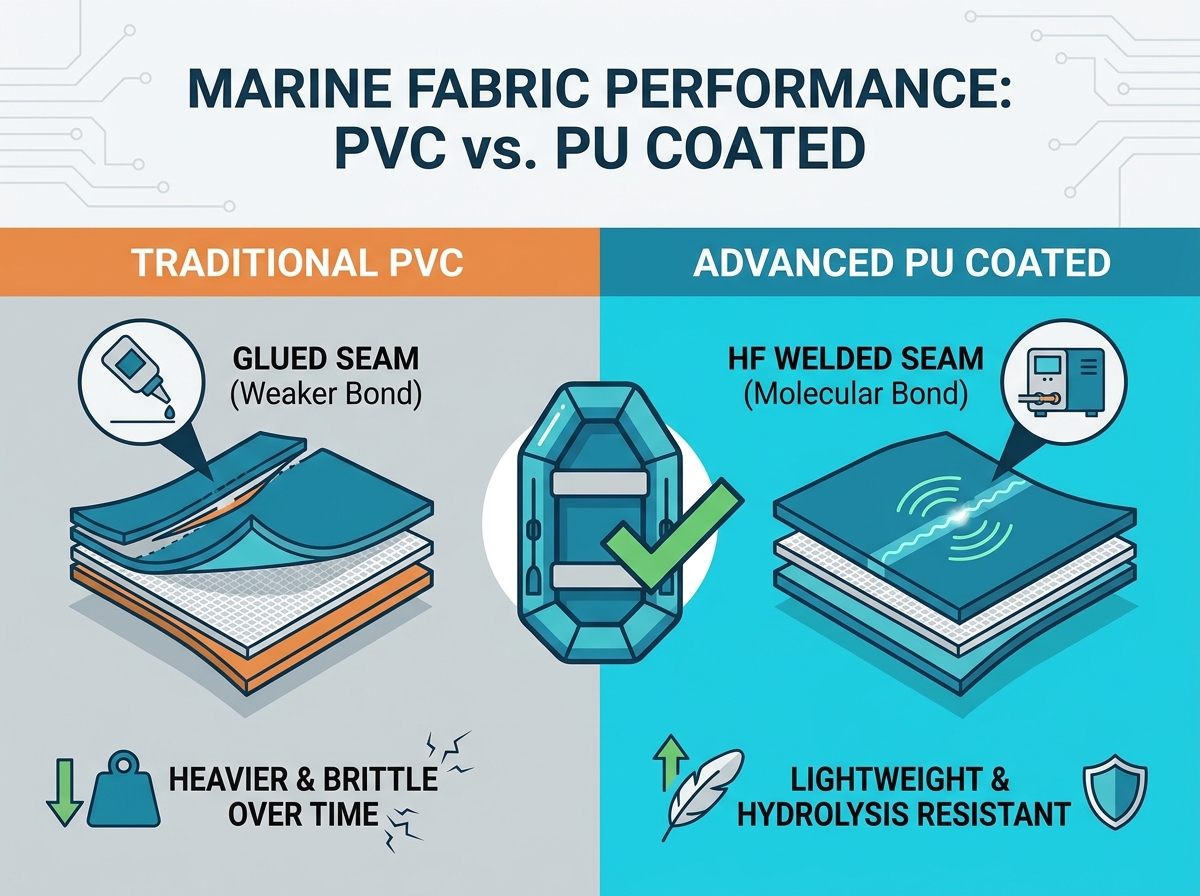
Modern polymer science gives manufacturers incredible new engineering tools. Polyurethane coatings fundamentally change how emergency survival rafts perform. They offer distinct physical advantages over legacy maritime materials.
Air retention directly saves lives at sea. PU coatings bond together at a flawless molecular level. Manufacturers primarily use high-frequency (HF) or hot air welding techniques. These automated methods melt the PU surfaces together permanently. The resulting seams are physically stronger than the base fabric itself. They eliminate the microscopic air leaks commonly found in manually glued joints. High-frequency welding presses the separate molecules into a single, unified layer.
Sharp floating debris and heavy impacts threaten raft integrity constantly. Life raft floors and buoyancy tubes need rigid, unyielding protection. Engineers specify a heavy duty pu fabric for these critical high-wear areas. Using 1000D+ base yarns provides massive structural strength. A dense weave prevents punctures from jagged wreckage during rescue operations. It also resists heavy abrasion when hauling rafts across rough ship decks.
Heavy rafts deploy slowly and clumsily during panic situations. You must balance extreme durability against practical packability. Using a highly compact lightweight pu tarp solves this engineering problem beautifully. It forms weather canopies and splash guards perfectly. The thinner profile folds tightly into small cylindrical storage canisters. You never sacrifice vital tensile strength for a lower overall weight. This crucial weight reduction drastically improves mechanical deployment speeds.
The open ocean unleashes UV radiation and fungal attacks continuously. Hydrocarbons like spilled diesel fuel and engine oil surround sinking vessels. PU naturally resists harsh UV degradation much better than alternative polymers. Fungal growth cannot easily take hold on its slick, non-porous surface. It repels toxic fuel and oil effectively during emergency water landings. These combined resistances prevent the fabric from breaking down prematurely under extreme duress.
Engineers often compare various synthetic polymers rigorously. You need accurate comparative data to choose your materials wisely. Evaluating every available option ensures optimal passenger safety and compliance.
Performance differences between these two plastics remain massive. Standard PVC relies heavily on volatile liquid plasticizers. These added chemicals give PVC its necessary initial flexibility. Unfortunately, they leach out of the plastic over time. The remaining fabric becomes brittle, stiff, and highly prone to cracking. PU completely lacks these migrating plasticizers in its chemical structure. It stays permanently flexible through inherent, stable molecular design.
Weight matters heavily during mechanical life raft deployment sequences. PU achieves equal tensile strength at a significantly lighter weight. The lower upfront cost of PVC tempts many procurement departments initially. However, PU provides a vastly superior, compliant operational service life.
Manufacturing methods differ greatly between these traditional and modern materials. PU allows for rapid, highly automated machine welding. Hypalon typically requires incredibly labor-intensive manual gluing processes. Workers must buff the fabric, apply toxic primers, and use complex two-part adhesives. Gluing introduces critical human error into the safety equation.
Maintenance and field repairability also favor modern PU fabrics heavily. PU allows for faster, more reliable patching under rough conditions. You can apply specialized pressure-sensitive adhesives easily in wet, chaotic environments.
Let us review these material differences through a comparative chart.
Performance Metric | Polyurethane (PU) | Standard PVC | Neoprene / Hypalon |
|---|---|---|---|
Flexibility Retention | Excellent (No plasticizer migration) | Poor (Chemicals leach out) | Good (Stable over time) |
Weight-to-Strength Ratio | High (Requires less mass) | Moderate (Thicker coating needed) | Low (Heavy base weight) |
Primary Seam Construction | Automated HF or Hot Air Welding | HF Welding | Manual Gluing and Curing |
Hydrocarbon (Fuel) Resistance | Exceptional | Moderate | High |
Maritime safety relies entirely on strict, enforceable regulatory frameworks. An approved inflatable life raft fabric must pass rigorous international testing protocols.
The Safety of Life at Sea (SOLAS) convention dictates strict manufacturing rules. The International Maritime Organization (IMO) enforces these global baseline requirements strictly. Commercial marine safety apparatuses must meet these standards legally. Failure to comply means vessels cannot operate in international waters. SOLAS certification proves the material can survive documented real-world oceanic disasters.
Engineers rely on specific ISO standards for objective laboratory validation. These standards remove guesswork from the material selection process.
ISO 15738 governs gas inflation systems for critical survival craft.
ISO 9650 outlines exact requirements specifically for small craft life rafts.
ISO 1421 dictates standardized tensile strength and elongation testing methods.
Fabrics must prove they perform flawlessly under these exact testing conditions. Independent auditors verify these results regularly to ensure ongoing factory compliance.
How do we know a raft will survive 15 years packed away? Manufacturers utilize specialized accelerated aging chambers. They expose fabric samples to intense heat, extreme humidity, and high UV light rapidly. You must carefully interpret this manufacturer testing data during procurement. Look closely at hydrostatic pressure retention scores after simulated aging. Examine tear strength levels after severe UV exposure. Verify that seam sheer strength remains intact over long simulated periods.
Testing Category | Standard Applied | Pass/Fail Criteria Example |
|---|---|---|
Hydrostatic Head Test | ISO 811 | No water penetration at specified high pressure limits. |
Accelerated Weathering | ISO 4892 | Maintains 80% tensile strength after 1000 hours UV exposure. |
Coating Adhesion | ISO 2411 | High peel strength preventing dangerous material delamination. |
Choosing the right factory dictates your product's ultimate survival capability. You must vet a pu coated tarpaulin manufacturer relentlessly before signing contracts.
Life-saving gear requires flawless, documented accountability across the board. A reliable supplier provides fully transparent batch-testing data immediately. They offer complete raw material sourcing documentation upon simple request. You need to trace every single fabric roll back to its original polymer batch. This traceability isolates potential defects quickly. It prevents catastrophic fleet-wide equipment recalls and saves millions in liability.
Advanced marine projects rarely use off-the-shelf catalog fabrics. Assess a supplier's ability to customize specific performance parameters accurately.
Modifying base fabric denier for exact structural strength requirements.
Adjusting specific weave types for varied, multidirectional tear resistance.
Controlling exact coating thickness measured in grams per square meter (GSM).
Integrating specialized flame-retardant (FR) chemical additives evenly throughout the matrix.
They must formulate the polymer specifically for your intended marine environment.
The best survival fabric remains totally useless if it arrives late. Evaluate their minimum order quantities (MOQs) closely during initial talks. Check their standard delivery lead times during known peak manufacturing seasons. Confirm the manufacturer possesses the operational capacity to scale up. They must grow seamlessly alongside your continuously increasing production demands. Supply chain bottlenecks delay crucial vessel deployments and cost shipyards money.
Do not commit to full-scale production runs blindly. Partner with a supplier who happily offers small sample runs initially. You need these physical samples for your own in-house HF welding trials. A competent factory provides robust technical support during this crucial prototyping phase. They should advise your engineers on optimal machine welding temperatures and operating speeds. This collaborative approach ensures perfect seam bonds before mass production begins.
Specifying advanced polyurethane polymers remains a highly strategic engineering investment. It guarantees absolute life-saving reliability when devastating marine emergencies occur. It protects your long-term brand reputation permanently in a heavily regulated industry. Procurement teams should take immediate, concrete action today.
First, audit your current material failure rates meticulously across your product lines. Second, define your exact technical specifications clearly for all upcoming new projects. Detail the required tensile strength, GSM, and environmental resistances precisely. Finally, contact a qualified manufacturer to request custom engineered samples. Run these advanced materials through your own in-house weld testing protocols immediately. Upgrading your materials today ensures zero catastrophic failures tomorrow.
A: High-quality polyurethane fundamentally resists chemical hydrolysis and degradation. It typically offers a fully compliant, packed lifespan ranging from 10 to over 15 years. This longevity depends heavily on specific onboard storage conditions and adherence to mandatory inspection schedules. Superior hydrolysis resistance ensures the fabric remains airtight and flexible until the exact moment of emergency deployment.
A: Yes, emergency field repairs are entirely possible and highly effective. Crews utilize specialized PU adhesives and patch kits designed specifically for wet marine conditions. These industrial adhesives bond directly to the PU surface coating seamlessly. They create a strong, airtight seal rapidly. This quick repairability proves crucial during extended survival scenarios on the open water.
A: Polyurethane carries a 30% to 50% higher initial material cost compared to standard PVC. However, this upfront expense offsets itself quickly. You gain massive automated manufacturing efficiencies through rapid high-frequency welding instead of manual gluing. You also benefit from reduced overall equipment weight and a doubled service longevity. This makes PU the undeniably smarter financial choice.


