


Author: Site Editor Publish Time: 2026-07-02 Origin: Site
Inadequate coverings expose agricultural assets to massive financial risks. Crop rot and spoiled hay destroy seasonal profits rapidly. Rusted outdoor equipment requires expensive mechanical repairs. Polyethylene (PE) remains the industry standard for cost-effective waterproofing solutions. However, massive quality discrepancies exist across the current market. Many buyers unknowingly purchase inadequate sheets disguised as heavy-duty covers. Standardizing your procurement process prevents these catastrophic losses entirely. This article provides a strict, specification-driven framework for evaluation. You will learn to identify top-tier materials accurately. We focus strictly on measurable specifications rather than generic marketing claims. We also explain how to vet suppliers effectively for commercial applications. You can confidently secure your assets against harsh environments. Protect your equipment today by mastering these core structural principles.
Core Specifications Matter: The lifespan of an agricultural pe tarpaulin is dictated by its GSM (Grams per Square Meter), weave density, and specific UV-stabilizing additives—not just visual thickness.
Construction Over Material: Even the highest-grade PE will fail under wind shear if edge reinforcements (rope-in-hem) and grommet quality are subpar.
Sourcing is Critical: Selecting a verified waterproof pe tarpaulin supplier who provides transparent batch-testing data is more cost-effective long-term than sourcing generic B2C alternatives.
Application Dictates Spec: A standard blue plastic tarpaulin sheet may suffice for temporary coverage, but multi-season outdoor shelters require specialized uv resistant pe tarp formulations.
Prolonged sun exposure aggressively attacks untreated polymers. Ultraviolet rays break down the molecular chains inside standard plastics. We call this chemical process photodegradation. The material loses all flexibility over time. It becomes highly brittle under direct sunlight. Eventually, the plastic flakes off in tiny pieces. Industry professionals call this the "plastic snow" effect. These microplastics contaminate your soil directly. They also leave the woven core exposed to rain. Once the outer coating fails, water penetrates the fabric instantly. You must prioritize proper chemical treatments to avoid rapid degradation.
High winds destroy weak materials rapidly. Flapping fabric generates tremendous mechanical stress. Tensioned installations amplify these destructive physical forces. You need a highly durable outdoor shelter cover pe to survive seasonal storms. Unreinforced edges cannot handle the constant kinetic energy. Grommets experience extreme localized pulling during violent gusts. Cheap steel grommets will literally tear through the plastic hem. This creates massive gaping holes instantly. The entire cover compromises itself within minutes. Strong hems distribute the wind load evenly across the entire perimeter.
Drastic temperature shifts damage inferior laminations constantly. Blistering summer days expand the plastics. Freezing nights contract them rapidly. This constant thermal cycling stresses the outer layers heavily. Low-Density Polyethylene (LDPE) provides the critical waterproofing seal. Poor manufacturing processes cause weak adhesion between these layers. The expanding materials eventually separate completely. We refer to this failure as delamination. Moisture enters the resulting air pockets. The structural integrity collapses shortly after. High-quality manufacturing ensures permanent bonding between the woven core and the outer seal.
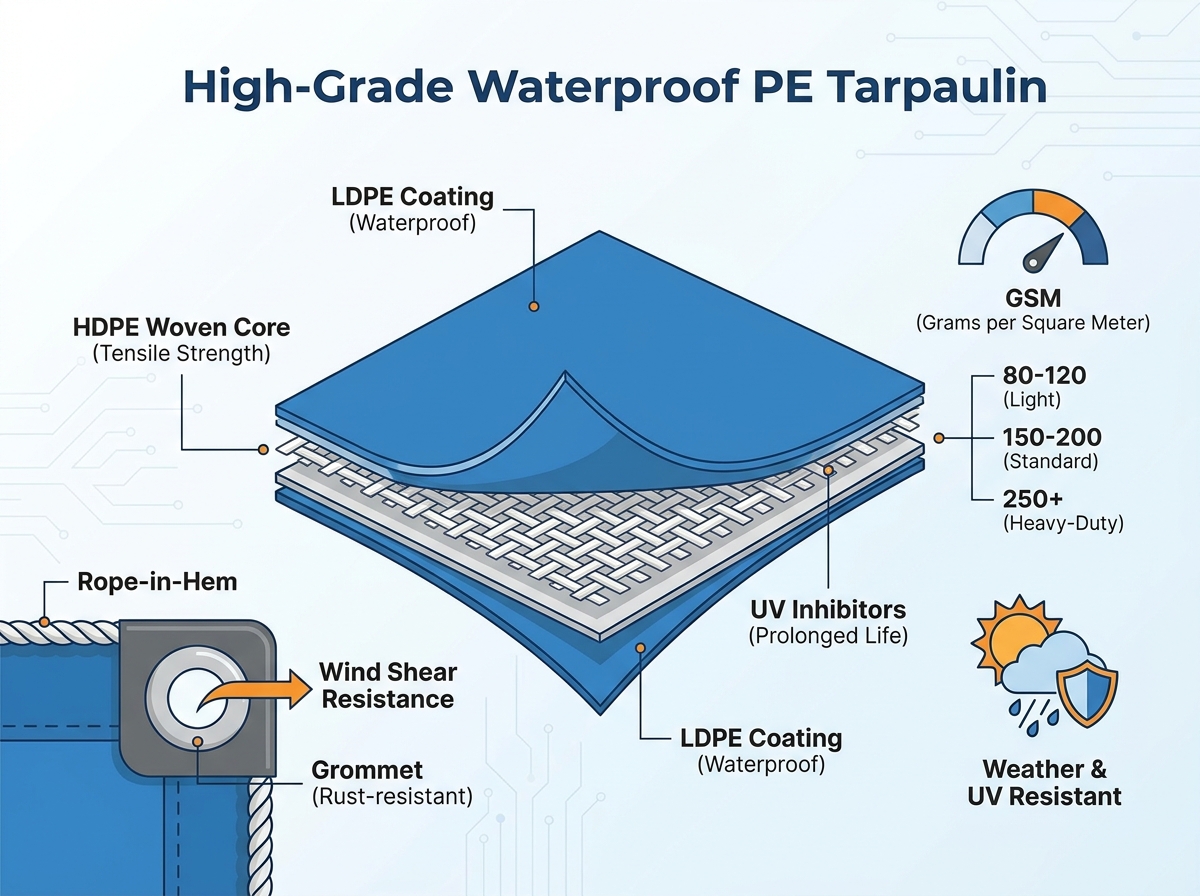
Let us examine the standard architectural design. Manufacturers use High-Density Polyethylene (HDPE) to create woven slit tapes. These interlocking tapes provide exceptional tensile strength. Factories then coat this core using LDPE. This outer layer guarantees a completely impermeable surface. A true waterproof pe tarpaulin requires an perfectly even coating. You should inspect the weave mesh closely. Look for a highly tight configuration. A 10x10 to 16x16 threads per square inch ratio offers excellent durability. Loose weaves stretch and distort under minor pressure.
Weight directly influences lifespan and durability. We measure this using Grams per Square Meter (GSM). You need a transparent baseline for procurement decisions.
PE GSM Baseline Guidelines
Category | GSM Range | Primary Application | Expected Lifespan |
|---|---|---|---|
Light-Duty | 80 - 120 GSM | Temporary ground cover, short-term dust protection | 1 - 6 Months |
Standard Farm | 150 - 200 GSM | Seasonal crop protection, equipment shielding | 1 - 2 Years |
Heavy-Duty | 250+ GSM | Multi-year outdoor shelters, extreme weather zones | 3+ Years |
We warn buyers to remain highly skeptical of inflated numbers. Some factories artificially increase GSM measurements. They blend recycled, impure fillers into the mix. This deceptive practice ruins the structural integrity. Virgin PE resin remains the only acceptable standard for commercial applications.
Surface sprays wear off extremely quickly. A genuine uv resistant pe tarp requires internal chemical integration. Quality factories add 3 to 5 percent UV inhibitors directly during the extrusion process. The protective chemicals become part of the plastic itself. This manufacturing method prevents premature brittleness in harsh climates. It ensures the material survives intense summer radiation.
Assess the hardware quality before purchasing any bulk order. Standard steel rusts quickly outdoors. You should demand brass or aluminum hardware instead. Evaluate the spacing intervals carefully. Grommets placed every 18 to 36 inches provide secure tie-down points. Heat-welded seams are absolutely mandatory. A poly-twine rope inserted inside the hem adds crucial edge reinforcement.
Agricultural products demand highly specific protective features. You need an impenetrable moisture barrier. A reflective surface reduces internal heat buildup significantly. Farmers often choose silver or white exteriors. High tear resistance protects against sharp plant stalks. An agricultural pe tarpaulin must survive rough handling during busy harvest seasons. Moisture trapped inside hay bales causes spontaneous combustion. Therefore, specialized breathable covers or vented setups become necessary.
Greenhouses require sustained static tension handling. The fabric stretches across metal hoops tightly. Plastic corner bars are absolutely mandatory. They distribute the massive corner stress across a wider area. These bars prevent friction wear against rigid shelter frames. You must inspect the corner reinforcements carefully. Weak corners lead to immediate structural failures during windstorms.
Sharp metal corners destroy thin sheets easily. You need robust medium-duty materials here. A standard blue plastic tarpaulin sheet works well for temporary machinery coverage. Dark colors hide grease stains effectively. High abrasion resistance prevents metal friction from ruining the protective cover. Ensure you pad sharp exhaust pipes before securing the fabric.
Polyethylene is significantly lighter than PVC or canvas. Heavy alternative materials require intense physical labor. Covering a massive hayrick takes multiple workers. Lightweight plastics make large-scale deployment highly manageable. Two workers can secure massive areas quickly. This reduces your overall labor dependency during critical weather emergencies.
Material Comparison Chart
Material Type | Weight Profile | Water Resistance | Rot/Mildew Immunity |
|---|---|---|---|
Polyethylene (PE) | Very Light | 100% Impermeable | Total Immunity |
Polyvinyl Chloride (PVC) | Very Heavy | 100% Impermeable | High Immunity |
Canvas | Extremely Heavy | Water Resistant (needs wax) | Prone to Rot |
PVC definitely lasts longer outdoors. However, heavy-duty PE offers the best ROI historically. Most agricultural production cycles run for one to three years. Over-investing in permanent covers wastes valuable capital. Buying high-grade PE aligns perfectly with typical farm budgeting cycles. You get excellent protection without the extreme upfront costs of PVC.
Canvas absorbs rain water rapidly. It becomes impossibly heavy when wet. PE repels water completely on contact. It remains naturally immune to mildew. This specific factor proves crucial for direct soil contact. Ground moisture destroys organic canvas fibers quickly. PE ignores ground moisture entirely, making it ideal for trench lining.
A legitimate waterproof pe tarpaulin supplier prioritizes consistent quality control above all else. They should easily provide official ISO 9001 certifications. Ask them about their factory GSM variance tolerances. Acceptable ranges hover around ±5%. High variance indicates poor manufacturing controls. You cannot afford inconsistent material thickness.
Demand hard proof regarding their virgin resin ratios. Recycled materials compromise tensile strength unpredictably. They also ruin UV resistance entirely. Ask the supplier directly about their extrusion process.
Ask for the exact percentage of virgin HDPE used in the woven core.
Request documentation showing zero recycled fillers in the LDPE coating.
Confirm the specific brand of UV inhibitors they inject.
Evaluate their custom manufacturing capabilities thoroughly. Can they deliver highly specific custom dimensions? Do they offer customized eyelet intervals? Dual-color laminations help adapt to regional climates greatly. A silver exterior reflects heat, while a black interior stops light penetration. Good factories accommodate these requests easily.
Never buy large bulk orders blindly. Request official data sheets immediately. You want to see hydrostatic pressure test results. Ask for tensile strength documentation specifically. The industry calls this physical test the grab test. Accelerated weathering test data proves actual UV resistance. Legitimate factories share these lab reports willingly.
Buying professional protective covers represents an investment in risk mitigation. It is never just a simple procurement checklist item. Financial losses from ruined crops far exceed the cost of premium materials. You must prioritize engineered specifications over generic brand promises. Base your final decisions on the triangulation of actual GSM, UV additive quality, and verifiable testing.
Do not select materials based solely on the lowest base price per square foot. Cheap materials fail when you need them most. Encourage your team to audit their current tarp failure rates carefully. Document where your current covers tear first. Finally, request technical spec sheets and physical samples from a shortlisted supplier before placing bulk seasonal orders.
A: A standard cover uses lower GSM weights and looser weave densities. Heavy-duty agricultural tarps feature dense weaves, higher GSM (250+), and specialized UV inhibitors. They also utilize reinforced corners and rust-proof hardware designed specifically for sustained outdoor tension.
A: A highly treated cover typically lasts between one to three years. The exact timeline depends heavily on the local UV index, continuous wind exposure, and proper installation tension. Loose installations degrade faster due to mechanical flapping.
A: Yes, PE is generally 100% recyclable under Resin ID Code 2 or 4. However, heavy dirt contamination and integrated metal grommets require special processing considerations. You must usually cut the metal rings off before sending the plastic to recycling centers.
A: Yes. Because the material is 100% impermeable, it traps ground moisture easily. You must use proper ventilation strategies when covering moisture-rich goods like curing hay. Without airflow, trapped condensation will rapidly cause severe mold and spoilage.


