


Author: Site Editor Publish Time: 2026-07-06 Origin: Site
Procuring industrial tarpaulin is not merely a routine commodity purchase. It represents a critical operational risk management decision for any large-scale project. Unplanned material exposure and sudden weather delays often cost thousands in rework. Stalled labor quickly drains project budgets when protective covers fail under pressure. However, sourcing reliable bulk materials remains notoriously difficult. Market claims about extreme durability and permanent weatherproofing frequently exaggerate real-world performance. Procurement teams often face a confusing maze of conflicting product specifications.
We want to clear up this confusion entirely. We will provide you with a verifiable, experience-based framework. You will learn exactly how to evaluate core material specifications properly. We will show you how to match these covers to actual site realities. Finally, you will discover the exact criteria needed to vet reliable supply partners. This guide ensures your site stays fully protected, compliant, and continuously operational.
True heavy-duty performance relies on 100% virgin resin; recycled blends compromise tensile strength and UV resistance.
Selecting the right GSM (Grams per Square Meter) and weave density must align with expected wind loads and duration of exposure.
Partnering directly with a qualified manufacturer ensures supply chain stability, custom width availability, and transparent batch testing.
Improper deployment (e.g., inadequate anchoring) is responsible for more site failures than actual fabric defects.
Industrial project managers constantly weigh competing material options. You must protect valuable site assets from unpredictable weather events. We often compare Polyethylene (PE) directly against Polyvinyl Chloride (PVC) and traditional canvas. Each material certainly serves a specific purpose on a job site. PVC definitely offers maximum longevity and chemical resistance. It stands up incredibly well to abrasive damage over several years. However, a heavy duty pe tarpaulin provides a vastly superior strength-to-weight ratio.
Workers can deploy PE rolls rapidly across massive structural areas. It remains highly cost-effective for large-scale, temporary-to-medium-term coverage. You avoid the extreme heavy lifting required for thick PVC. A standard crew requires forklifts to maneuver massive PVC bundles. Conversely, two workers can easily unroll and position large PE sections. This rapid mobility translates directly into lower labor hours.
Next, consider the crucial difference between raw plastic components. You must mandate the use of a virgin plastic tarpaulin roll for any structural cover. Many generic suppliers use recycled resins to lower their production costs. Recycled plastics inevitably introduce microscopic structural weaknesses. These invisible flaws propagate sudden tears under high wind stress. They also fail much faster during severe freeze-thaw cycles in winter. Virgin resin ensures consistent molecular integrity throughout the entire fabric layer.
Material Type | Weight Profile | Cost Efficiency | Ideal Construction Use Case |
|---|---|---|---|
Polyethylene (PE) | Light to Medium | High | Large-scale scaffolding, material staging, temporary roofs. |
Polyvinyl Chloride (PVC) | Very Heavy | Low | Permanent structures, heavy machinery long-term transport. |
Canvas | Heavy | Moderate | High-heat environments like asphalt transport. |
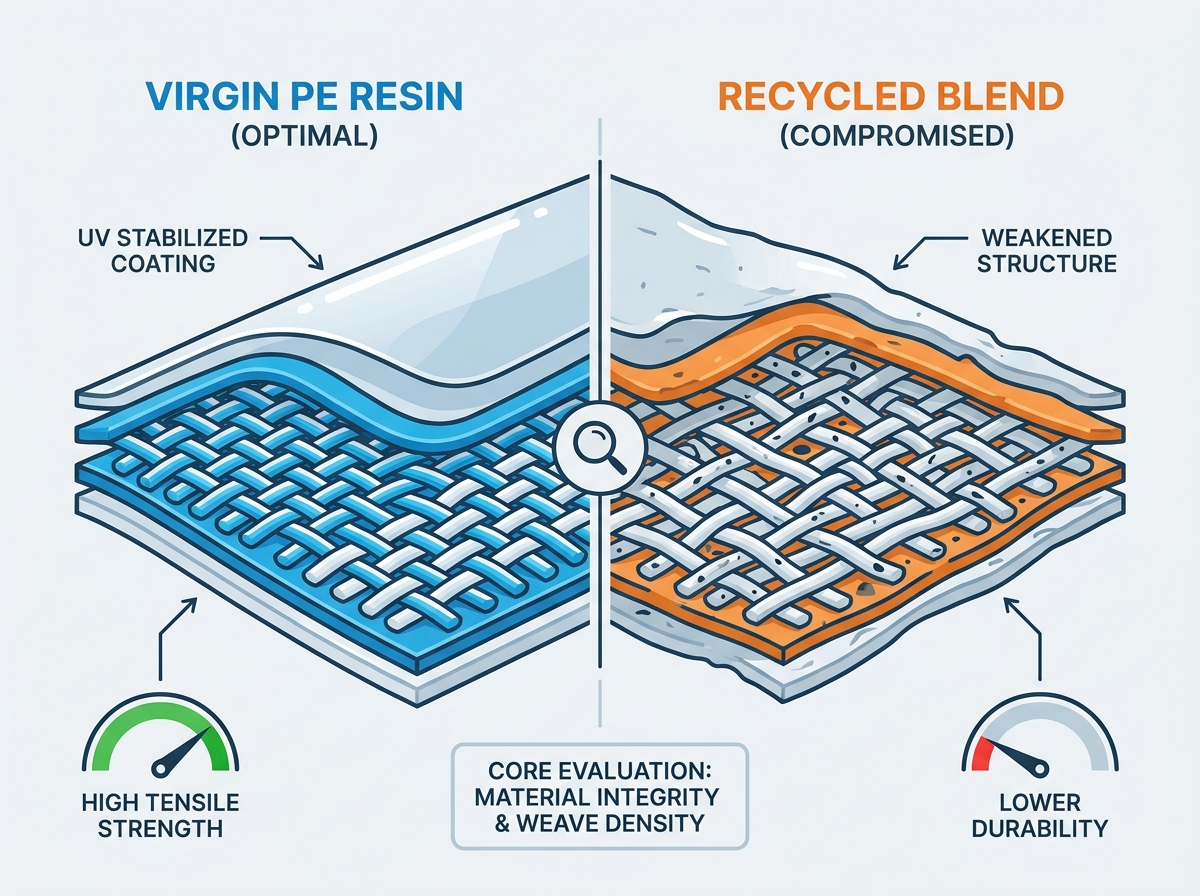
Buyers often assume thicker always means better. This logic is fundamentally flawed in modern procurement. You must evaluate the base fabric weave alongside the outer coating thickness. We measure weave density in yarns per inch. Common structural configurations include 14x14 or 16x16 counts. A dense underlying core creates incredible tear resistance against sharp objects. Exposed steel pipe joints easily slice through inferior materials. If you select a high GSM cover without a tight weave, it fails quickly. Puncture stress will easily separate loose underlying yarns. A reliable industrial construction pe fabric balances heavy coating layers directly over a tightly woven scrim.
We also need to address severe sunlight degradation. UV stabilization dictates your true project lifespan. Manufacturers must extrude UV inhibitors into both the underlying tapes and the outer lamination. Think of UV resistance as a measurable half-life. It is never a permanent feature. Prolonged sun exposure eventually breaks down all plastics. Southern climates accelerate this degradation dramatically. You should request clear degradation timelines from your supplier before ordering.
Safety compliance is another critical evaluation dimension. Hot work zones require highly specialized materials. Enclosed scaffolding and welding areas pose severe fire risks. You must deploy a certified fireproof pe tarp in these sensitive site locations. Flame retardant chemicals prevent rapid fire spread across temporary structures. Ensure your materials strictly meet OSHA and NFPA 701 compliance standards. Overlooking this specific detail invites massive legal liability and site shutdowns.
Different project zones require specific material configurations. Standard weather protection demands practical, fast solutions. Teams frequently deploy a standard blue pe cover sheet for everyday tasks. They work perfectly for temporary material staging areas. You can use them effectively as short-term moisture barriers before pouring concrete. They also easily cover loose aggregate piles during light rain. However, recognize their operational limitations. Standard blue sheets degrade faster in long-term high-sun environments. You should plan to replace them periodically on multi-year projects.
Heavy construction environments demand upgraded solutions. Prolonged asset protection requires highly specialized configurations. Consider high-visibility colors for active machinery zones to improve safety. Alternatively, use blackout silver or black tarps for temporary roofing. Silver outer layers reflect intense solar heat away from the building. Black inner layers completely block light penetration. This combination stabilizes temperatures inside climate-controlled work enclosures.
Procurement teams must also carefully analyze product dimensions. You have two primary ordering paths available. Ordering raw bulk rolls offers maximum on-site flexibility. Crews simply cut the exact lengths they need dynamically. This approach reduces overall material costs significantly. Conversely, pre-fabricated sizes offer immediate deployment speed. They arrive complete with reinforced hems and heavily spaced grommets. Carefully calculate your expected site labor costs. Cutting and securing raw rolls takes valuable man-hours. Pre-made sizes install much faster but cost slightly more upfront.
Sourcing materials efficiently requires intelligent supply chain consolidation. You gain a significant strategic advantage by bypassing regional intermediaries. You should work directly with a heavy duty pe tarpaulin factory whenever possible. Direct factory partnerships ensure better pricing models and superior technical communication. They also eliminate frustrating middleman stock shortages.
You must rigorously audit their technical production capabilities. Here is what you should actively look for during evaluation:
Multi-layer co-extrusion technology: This ensures superior layer adhesion and prevents peeling.
Maximum seamless roll widths: Fewer seams logically mean fewer potential failure points under wind stress.
Automated heat-welding machinery: This provides completely waterproof joints that outlast traditional stitching.
In-house raw material blending: This proves they control the virgin resin quality directly.
Trustworthy manufacturers provide absolute quality assurance transparency. Never accept vague promises about general fabric strength. Request documented test results before placing bulk orders. A reputable factory willingly shares recent tensile strength testing data. They conduct hydrostatic pressure tests to prove their waterproof claims definitively. They also provide accelerated weathering chamber data to validate UV resistance claims.
Finally, assess their customization flexibility. Project blueprints often dictate highly unique material requirements. A strong factory modifies UV inhibitor ratios based on your exact regional climate. They apply custom flame-retardant coatings for your specialized safety zones. They can easily adjust grommet or D-ring spacing to match your exact structural scaffolding frames.
Even the best materials fail if crews deploy them incorrectly. We must firmly address the persistent wind shear fallacy. Many site managers immediately blame the fabric when a blowout occurs. In reality, 90% of tarp blowouts result from insufficient tie-downs. Fabric failure is rarely the primary structural culprit. Rigid ropes create highly destructive tension points at the grommets. You must use flexible bungee ties instead. Bungees dynamically stretch and safely absorb sudden wind gusts. This simple adjustment dramatically extends material life across the entire site.
Storage degradation presents another hidden operational risk. Warn your logistics teams against improper on-site storage practices. Rolls left sitting in standing water absorb moisture through their unsealed edges. Rolls exposed to extreme surface heat prior to deployment suffer severe damage. Premature delamination often begins before the material ever covers a single structure. Always store all rolls off the ground in shaded, dry containers.
Do not make blind lead time assumptions. Specialized custom rolls require longer manufacturing and shipping schedules. You face severe supply bottlenecks if you order late in the season. Always advise your procurement buyers to forecast timelines accurately. Secure your bulk orders well ahead of major seasonal weather shifts. Waiting until hurricane or heavy storm season guarantees elevated prices and disastrous shipping delays.
Procuring reliable site protection demands a highly structured decision funnel. First, explicitly verify the manufacturer uses 100% virgin resin. Next, carefully match the GSM and weave density to your specific structural application. Always require official compliance documents for any hazardous safety zones. Finally, audit your chosen factory for modern, automated production capabilities.
Take immediate action to secure your operational supply chain. We recommend requesting physical material samples today. Test the ply adhesion and general stiffness yourself. Ask your shortlisted manufacturers for comprehensive technical data sheets. Clear technical data eliminates expensive guesswork and ensures successful, continuous project protection.
A: A high-quality PE cover typically lasts between 6 to 24 months under continuous exposure. This lifespan depends heavily on specific UV intensity, the fabric's GSM, and proper tensioning during installation. Avoid manufacturers making impossible "lifetime" claims for active industrial environments.
A: Common bulk roll dimensions usually start around 2 meters wide by 100 meters long. However, direct factory sourcing allows for highly customized widths and lengths. Custom sizing helps minimize site waste and reduces the labor required for cutting and joining panels.
A: Yes, 100% PE tarps are technically recyclable under Category 4 (LDPE/HDPE) guidelines. However, you face practical recycling challenges on industrial sites. Heavily soiled, chemically contaminated, or physically degraded materials are often rejected by standard municipal recycling facilities.


