


Author: Site Editor Publish Time: 2026-05-31 Origin: Site
Selecting the wrong temporary coverage disrupts projects. It damages valuable inventory. It seriously compromises site safety. A single unexpected storm can easily ruin weeks of hard work if your protective barriers fail. Unfortunately, many buyers default to generic specifications when sourcing these materials. They ignore critical variables like exact project duration, extreme environmental stress, and core hardware integrity. This widespread oversight frequently causes premature tearing, dangerous structural leaks, and costly mid-project replacements.
Our guide provides a comprehensive, procurement-grade evaluation framework. It specifically targets site managers, purchasing agents, and project directors. By understanding these technical criteria, you will learn how to specify the exact material required for your unique applications. We aim to help decision-makers secure reliable protection for their construction or industrial sites. You will gain the knowledge needed to order precise specifications without needlessly overspending.
Match the Grams per Square Meter (GSM) to project duration; standard PE is highly cost-effective for sub-6-month projects, while heavy-duty variants handle up to 2 years.
True waterproofing requires heat-welded or RF-welded seams, not standard stitching.
Hardware matters: Specify reinforced hems, corner patches, and anti-rust grommets spaced every 1-2 feet for high-wind environments.
Site compliance often dictates color choice; high-visibility or specialized colors enhance Health, Safety, and Environment (HSE) protocols.
Always calculate purchasing dimensions with a minimum 1-foot overlap allowance for secure installation.
You must establish your baseline requirements before looking at material specifications. Knowing exactly how and where the cover will function prevents critical failures. Site managers must first evaluate both the expected timeline and the localized climate conditions.
Your project timeline directly dictates the necessary material strength. Specifying excessive durability for a short job wastes budget. Under-specifying for a long project risks catastrophic failure.
Short-Term (< 6 months): Standard woven polyethylene provides the highest return on investment. It allows rapid deployment. It offers excellent temporary protection against unpredictable weather.
Medium-Term (1-3 years): You require upgraded materials. Specify a UV-treated, high-density polyethylene (HDPE) core. It must feature multi-layer lamination to resist prolonged sun exposure.
Different climates exert different physical stresses on protective fabrics. You must match the material chemistry to your local environment.
Concrete Curing Applications: Contractors utilize moisture-locking properties. They cover newly poured concrete to prevent rapid drying. This specific application stops surface cracking and ensures maximum structural strength.
Wind & Thermal Variables: You must assess extreme temperature tolerance. Freezing climates require cold-crack resistance. High-wind environments demand appropriate securing mechanisms. These mechanisms prevent wind-shear tearing along the edges.
GSM stands for Grams per Square Meter. It serves as the standard measurement for fabric thickness and density. Translating GSM into actionable use cases helps you order correctly.
GSM Range | Duty Classification | Ideal Applications |
|---|---|---|
50–150 GSM | Light to Medium Duty | Indoor storage, dust barriers, low-impact coverage. |
150–300 GSM | Construction & Industrial Grade | Scaffolding enclosures, roofing, machinery protection. |
>300 GSM | Heavy-Duty / Specialized | Continuous outdoor exposure, severe storm protection. |
This category works best for indoor storage and simple dust barriers. It provides temporary, low-impact coverage. It prioritizes ease of manual handling. Workers can deploy it rapidly over large areas. However, it lacks high puncture resistance.
These weights are strictly essential for PE tarpaulin temporary coverage construction scenarios. Manufacturers design them specifically for scaffolding enclosures and temporary roofing. They protect heavy machinery from harsh weather. They balance durability with manageable weight.
Engineers design this grade for high abrasion resistance. It handles extreme weather effortlessly. You need this category for continuous outdoor exposure in punishing environments.
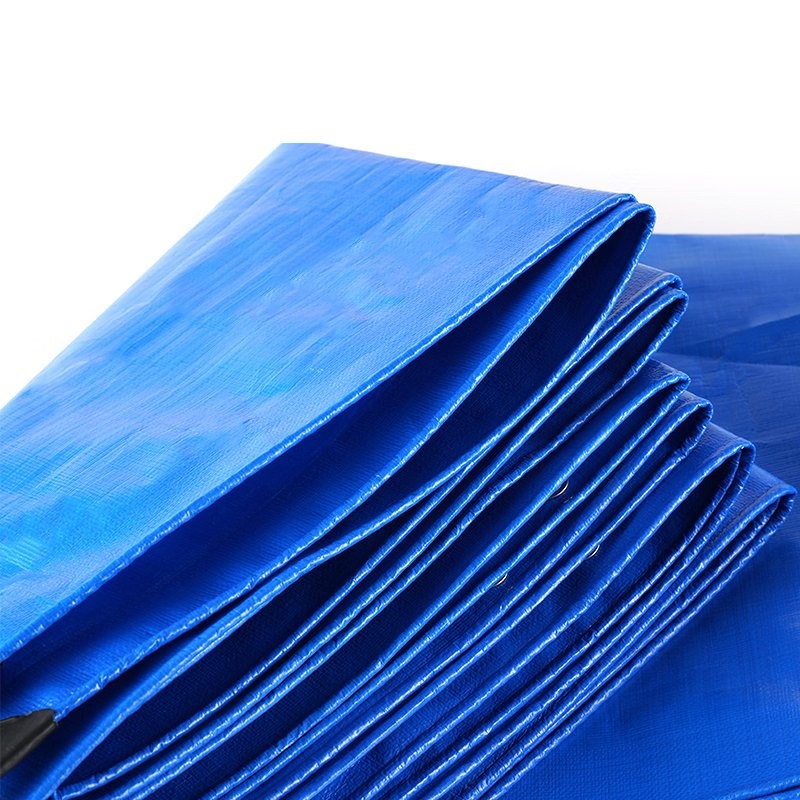
Buyers must know how to identify genuine manufacturing quality. Dodging substandard products saves significant time and money. Focus heavily on layer construction, seam sealing, and reinforced hardware.
Not all protective sheets share the same internal structure. You must differentiate between basic and advanced designs.
Standard 3-Layer: This features one woven core sandwiched between two outer coatings. It suits general applications well.
Advanced 5-Layer: This structure utilizes multiple woven cores or extra protective coatings. It delivers significantly enhanced durability against punctures and abrasions.
Do not compromise on seam construction. You must demand high-frequency (RF) welded or heat-welded seams. Traditional needle-stitched seams create thousands of tiny pinholes. These holes completely compromise 100% water resistance. A PE tarpaulin only guarantees dry cargo if its seams are thermally fused.
The edges handle the majority of wind stress. Proper hardware keeps the fabric securely anchored.
Verify the presence of poly-rope reinforced hems. The factory heat-seals a rope inside the outer edge.
Check for rust-resistant grommets. Aluminum or solid brass works best. They must sit every 12 to 24 inches for proper tension distribution.
Ensure heavy-duty plastic corner patches are firmly integrated. They prevent corner blowouts during severe wind gusts.
Brief your procurement teams on basic physical tests. These methods quickly verify material composition when you audit new suppliers.
The Float Test: Polyethylene inherently floats on water. Conversely, PVC sinks immediately.
Burn Characteristics: Polyethylene smells similar to burning candle wax. It drips slightly while burning. PVC emits a harsh, pungent odor and stops burning quickly once removed from the flame.
B2B procurement involves strict corporate and regulatory requirements. Material choice directly impacts Health, Safety, and Environment (HSE) protocols on active sites.
Color serves specific functional and psychological purposes. It is rarely just an aesthetic choice.
High-Visibility (Orange/Yellow): This effectively demarcates hazardous zones. It aligns perfectly with global site safety protocols.
White/Silver: These shades aggressively reflect heat. They protect temperature-sensitive materials stored underneath from solar baking.
Clear/Translucent: This style allows natural light penetration. It keeps enclosed scaffolding and winter work areas safely illuminated.
Always request documentation from your suppliers. Checking for ISO 9001 manufacturing standards ensures consistent factory output. You must also evaluate the necessity of Fire Retardant (FR) certifications. High fire risk sites require stringent FR compliance to pass safety inspections.
Large contractors leverage OBM (Original Brand Manufacturer) capabilities. They request custom logo printing directly onto the fabric. This turns functional coverage into massive site branding. It also serves as visual security identification, strongly deterring job site theft.
A massive gap often exists between purchasing theory and actual site implementation. A perfect material specification still fails if your team installs it poorly.
Standard industry practice strictly dictates how you calculate dimensions. Never buy exact measurements. You must purchase tarps large enough to allow at least a 1-foot overlap on all adjoining sides. This generous overlap prevents driving rain from pushing water backward through the seams.
Improper tensioning destroys fabrics faster than UV exposure.
Avoid Point-Loading: Never tie down a massive sheet using just one or two grommets. The concentrated wind force will rip the metal rings straight out of the fabric.
Use Bungee Ties: Rigid ropes transfer harsh shockwaves directly to the fabric. Bungee ties stretch. They safely absorb the kinetic energy of strong wind gusts.
Maintain Tension: Keep the surface completely taut. Loose sections pool heavy water. They also flap violently in the wind. Wind-flapping degradation shreds synthetic fibers in mere days.
Strict protocols extend product lifespans significantly. Clean the surfaces using only mild soap and clean water. Never apply harsh industrial chemicals. You must ensure the material is 100% dry before folding it. Storing damp plastic creates aggressive mold growth. This mold permanently weakens the lamination layers.
Buyers often struggle between choosing polyethylene or polyvinyl chloride. A transparent comparison helps you finalize your shortlisting logic effortlessly.
Feature | Polyethylene (PE) | Polyvinyl Chloride (PVC) |
|---|---|---|
Weight | Lightweight, easy manual handling. | Very heavy, requires team lifting. |
Cold Flexibility | Excellent. Resists cracking in frost. | Can become rigid in extreme cold. |
Expected Lifespan | Up to 2-3 years depending on GSM. | 5 to 10+ years under harsh conditions. |
You should choose a PE tarpaulin when budget and mobility matter most. It is highly cost-effective. It weighs significantly less, allowing frequent manual handling by smaller crews. It maintains excellent flexibility in cold weather. It stands as the optimal choice for short to medium-term temporary coverage.
You only need to upgrade to PVC for highly specific, demanding scenarios. It is strictly necessary for permanent installations lasting beyond five years. It handles extreme ambient heat resistance well. It survives severe heavy-haulage transport requirements over highways. However, you must keep in mind the substantial weight penalty and the much higher initial purchase price.
Successful site protection depends entirely on aligning three factors. You must accurately match your project duration, your GSM requirements, and your core hardware quality. Stop guessing with generic options. Investing upfront in factory-verified details—like RF-welded seams and solid corner reinforcements—drastically reduces unpredictable replacement costs. It also noticeably lowers physical site risks. We strongly advise all buyers to thoroughly audit their specific site dimensions and extreme environmental risks today. Complete this crucial evaluation before requesting new supplier quotes.
A: Lifespan heavily depends on UV degradation and GSM correlation. A standard mid-weight sheet generally lasts 1 to 2 years under continuous outdoor exposure. Heavier thickness and premium UV treatments can extend this slightly.
A: Yes, the core material itself is inherently waterproof. However, true site waterproofing depends entirely on heat-welded seams. Standard stitched seams contain tiny needle holes that allow water to seep through during heavy rain.
A: Cut size refers to the raw fabric before processing. Finished sizes are typically 3-5% smaller because factories fold the edges inward to create reinforced hems. Always warn buyers to size up accordingly.
A: Yes. You can repair small punctures quickly using specialized PE repair tape. However, if a large tear occurs across a major tension point, full replacement logic applies to maintain site safety.


