


Author: Site Editor Publish Time: 2026-07-01 Origin: Site
Fleet operators and logistics providers lose significant revenue annually due to compromised cargo. Substandard truck covers frequently fail during transit. This failure leads directly to costly freight damage. This hidden leak in profitability demands immediate attention. The upfront cost of a new tarp remains negligible compared to the liabilities of ruined freight. However, evaluating supplier specifications remains highly opaque for many procurement teams. Navigating technical metrics like GSM, yarn density, and coating methods often confuses even experienced buyers. We provide a transparent, specification-driven framework for evaluating these critical materials. You will learn how to parse technical data sheets effectively. You will understand exactly how to select a reliable heavy duty pvc tarpaulin manufacturer. This guide ensures your next procurement decision prioritizes long-term resilience. It helps you maximize long-term cost efficiency over cheap, short-lived alternatives.
Material Selection: Optimal truck covers require knife-coated PVC (typically 600–900 GSM) for superior peel strength and weather endurance compared to standard laminated alternatives.
Performance Metrics: Tearing strength, UV degradation resistance, and cold-crack ratings are the primary indicators of field longevity.
Supplier Vetting: Partnering with a verifiable manufacturer ensures access to consistent batch quality, custom formulations (e.g., flame retardance), and reliable supply chains.
Cost Efficiency: Focusing on lifecycle cost rather than per-roll pricing prevents premature replacement and operational downtime.
Procurement teams must carefully evaluate the lifecycle equation of their materials. Standard polyethylene (HDPE) tarps usually fail within a rapid six-month window. They degrade quickly under harsh highway conditions. Conversely, a premium heavy duty pvc tarpaulin delivers a highly reliable three-to-five-year lifecycle. This extended durability significantly reduces replacement frequency. It keeps your trucks on the road longer. It minimizes costly maintenance interruptions.
Truck covers endure brutal environments every single day. Aerodynamic whipping creates intense mechanical stress at high speeds. This constant vibration tests the structural limits of any fabric. Abrasive friction from tight tie-downs continuously wears down the material surface. Furthermore, extreme temperature fluctuations cause continuous thermal expansion and contraction. High-quality materials must absorb this daily punishment without tearing.
How do we define a successful field deployment? A successful cover guarantees zero water ingress during heavy storms. It demonstrates minimal structural fatigue even after one hundred highway trips. Fleet managers also require predictable maintenance schedules. Unplanned tarp failures disrupt complex logistics networks. They damage valuable client relationships. Baseline standards exist specifically to prevent these operational disasters.
Engineers measure material weight in Grams per Square Meter (GSM). However, GSM alone tells an incomplete story. You must balance overall weight alongside the base polyester mesh strength. Industry professionals measure this underlying yarn strength in Denier. A high GSM without a strong Denier yields a heavy, surprisingly weak cover. The core strength always relies on the underlying woven polyester mesh.
We recommend specific target ranges for optimal field performance. For a highly durable waterproof truck cover tarpaulin, specify a baseline of 1000D x 1000D yarn. The finished weight should typically fall between 610gsm and 900gsm. This specific sweet spot ensures maximum tear resistance. It also maintains reasonable handleability for daily use.
Consider the operational trade-offs carefully. Heavier fabric is not universally better for every application. Excess weight physically exhausts drivers during manual handling. It complicates daily loading operations. Furthermore, simply adding more PVC coating does not inherently improve tear resistance. It only adds unnecessary dead weight.
Best Practices: Always ask suppliers to specify both GSM and yarn Denier clearly.
Common Mistakes: Purchasing 1200gsm material expecting superior strength, only to discover weak 500D yarn inside.
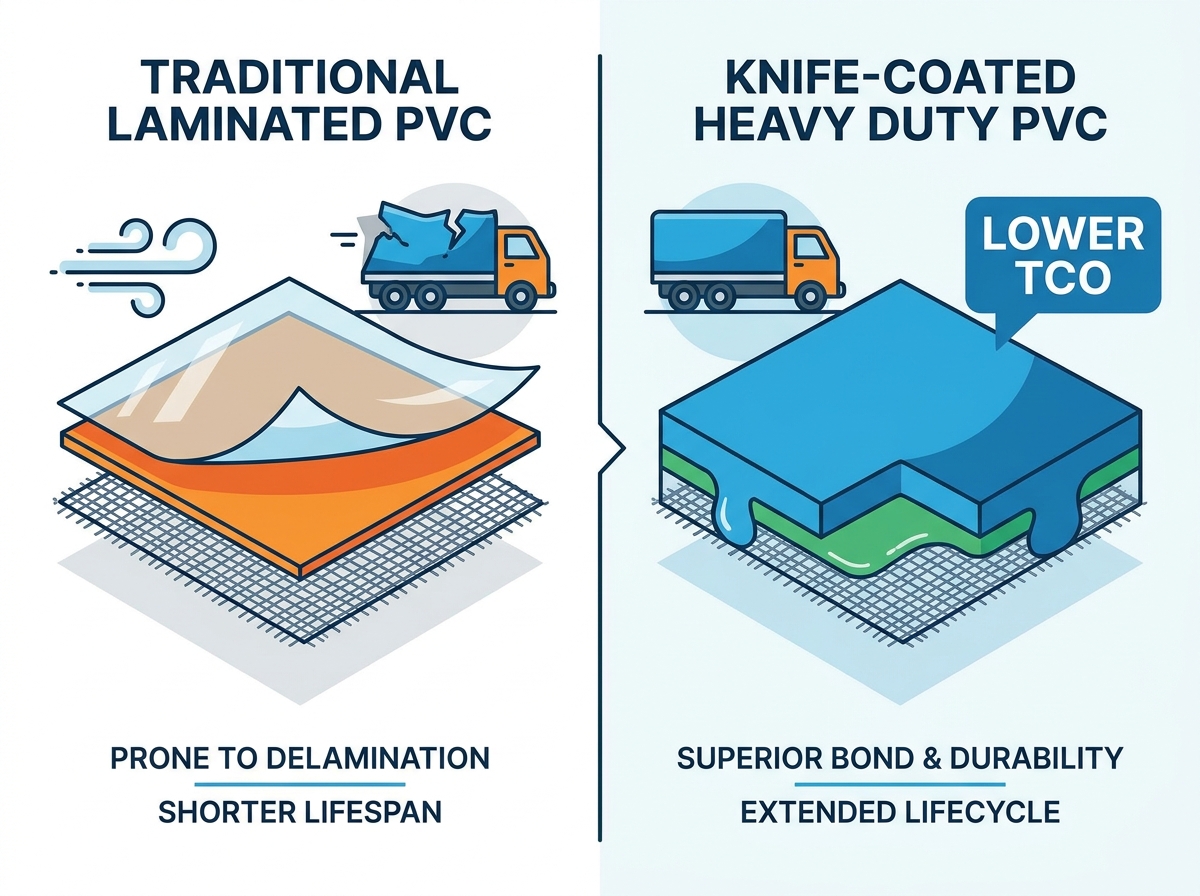
Manufacturing methods drastically impact real-world field performance. The critical difference lies directly in chemical adhesion. How strongly does the PVC bond to the polyester mesh? This single metric dictates the lifespan of your truck cover.
Let us examine laminated rolls first. Factories produce them by pressing solid PVC films onto the mesh using heated rollers. They are significantly cheaper to manufacture. Unfortunately, they remain highly prone to rapid delamination. High wind stress peels these laminated layers apart over time. The fabric eventually separates and fails completely.
Knife-coated rolls offer a vastly superior alternative. During this advanced process, machines scrape liquid PVC directly into the fabric matrix. The liquid resin fully penetrates the woven polyester yarns. This method provides exceptional chemical durability. It ensures high flex resistance. It guarantees long-term longevity for heavy-duty commercial applications.
Consider your procurement format carefully. Buying bulk materials, such as a coated pvc tarpaulin roll, suits fleets possessing internal fabrication shops. Pre-fabricated sizes make more sense for operations lacking custom welding capabilities.
Comparison of Coating Technologies
Feature | Knife-Coated PVC | Laminated PVC |
Adhesion Strength | Excellent (Liquid penetration) | Poor to Moderate (Surface bonding) |
Flexibility | High (Resists cracking) | Low (Prone to stiffness) |
Production Cost | Higher upfront investment | Lower initial price |
Delamination Risk | Virtually non-existent | High under wind stress |
Continuous sun exposure quickly destroys untreated plastic materials. Raw PVC degrades rapidly outdoors. It hardens, becomes highly brittle, and eventually cracks. You must demand verified UV-resistant lacquer coatings. Premium manufacturers apply specialized Acrylic or PVDF topcoats. These clear barriers block harmful ultraviolet radiation effectively. They stop the dreaded chalking effect entirely.
Temperature extremes also pose significant threats to fleet equipment. Regional logistics often cross diverse climates in one trip. You need reliable cold crack resistance. Specify materials explicitly tested to perform between -30°C and -40°C. High-quality plasticizers ensure the fabric maintains essential flexibility in freezing conditions. Cheap plasticizers simply freeze and shatter.
Fire safety compliance remains non-negotiable for specific transport routes. Some cargo types legally mandate the use of a flame retardant trailer tarp. Always reference established international fire standards. Look for DIN 4102 B1 or NFPA 701 laboratory certifications. These strict frameworks verify the material will self-extinguish when exposed directly to fire.
Environmental moisture introduces another serious maintenance challenge. Tarps frequently get rolled up while completely wet. This dark, damp environment breeds aggressive fungal degradation. Assess surface treatments carefully during procurement. Self-cleaning and anti-mildew additives prevent mold from eating into the fabric matrix. They keep the cover sanitary, clean, and structurally sound for years.
Selecting the right factory requires rigorous evaluation. Not all suppliers operate equally. You need a structured vetting approach to avoid costly mistakes.
First, assess their internal production capabilities. Look for suppliers managing end-to-end production. They should weave the base mesh internally. They should apply the coating on their own lines. They must handle final finishing independently. Avoid pure assemblers who merely buy and weld third-party rolls. End-to-end control guarantees consistent batch quality.
Second, evaluate their cross-industry competence. Top-tier factories rarely serve just one single sector. Producing highly regulated materials demonstrates rigorous internal standards. For example, a facility manufacturing industrial roofing pvc fabric possesses strict quality control systems. These exact systems greatly benefit truck tarp production. They ensure zero-tolerance defect policies.
Third, demand absolute testing and QA transparency. Do not accept verbal assurances from sales representatives. Request official batch-testing reports. You need verified laboratory data on tensile strength. You need accurate numbers on tear strength and coating adhesion. Reliable manufacturers provide these vital documents unprompted.
Finally, review their customization capacity. Superior suppliers adjust plasticity based on your specific climate. They formulate exact color fastness requirements. They also offer extra-wide roll widths, sometimes up to 5.1 meters. Wider rolls reduce the number of weld seams required during final fabrication. Fewer seams mean fewer potential weak points.
Follow this checklist when vetting suppliers:
Verify end-to-end manufacturing machinery via video tours or audits.
Request multi-industry product portfolios to judge broader competence.
Analyze three recent batch-testing laboratory reports for consistency.
Confirm maximum output roll widths to optimize your fabrication process.
Even the finest materials require proper handling. Excellent fabric cannot overcome poor fabrication techniques. Maintenance protocols heavily influence ultimate longevity.
Let us discuss fabrication weak points. High-frequency (HF) welding joins individual panels together permanently. The specialized machinery applies specific heat, speed, and pressure. Incorrect parameters will ruin premium fabric immediately. Too much heat scorches the PVC resin. Too little pressure creates weak, temporary bonds. These compromised seams will inevitably fail under highway wind loads.
Field repairability matters immensely in commercial logistics. Accidents happen frequently on the road. Low-hanging branches tear covers. Forklifts puncture side curtains accidentally. We must face actionable realities regarding PVC patching. Knife-coated materials accept hot-air welding repairs beautifully. The liquid-bonded matrix melts seamlessly into new repair patches. Laminated variants often peel further during hot-air repairs, destroying the surrounding area.
Cleaning protocols heavily influence the material lifespan. Fleet washers often grab the strongest degreasers available to save time. Warn your maintenance teams explicitly against harsh petrochemical solvents. These aggressive chemicals strip away the protective UV topcoats. Once the topcoat vanishes, the PVC degrades rapidly. We strongly recommend neutral pH industrial cleaners. Gentle, consistent cleaning extends functional life by years.
The choice of truck tarpaulin dictates long-term fleet maintenance costs. Base fabric denier directly determines underlying mechanical strength. Knife-coating methodology ensures inseparable chemical adhesion. Specialized environmental additives guarantee predictable performance in harsh weather. Ignoring these critical specifications guarantees premature failure and increased operational headaches.
Advise your procurement teams to take the following next steps:
Request physical A4 material samples to test flexibility manually.
Demand comprehensive Technical Data Sheets (TDS) for every proposed fabric.
Verify ISO certifications to ensure consistent manufacturing standards.
Conduct small-scale hot-air weld tests on samples before committing to bulk roll orders.
A: Load-bearing side curtains typically require 900gsm material to handle internal cargo shifts and extreme wind tension safely. Standard top covers on flatbeds perform excellently between 600gsm and 700gsm, balancing durability with manageable weight for drivers.
A: Yes, but it requires specialized mechanical recycling. Facilities must shred the composite PVC and polyester materials. They then separate the elements or grind them down to create secondary industrial products like traffic cones and floor mats.
A: You must request independent third-party laboratory certificates. These official documents must correspond directly to specific international fire codes, such as DIN 4102 B1 or NFPA 701. Do not accept internal factory tests as sole proof.
A: Cold-cracking occurs when low-quality plasticizers freeze and become highly brittle. Manufacturers prevent it by using high-quality polymeric plasticizers instead of cheaper monomeric options during the initial resin formulation process. This ensures flexibility at -30°C.


