


Author: Site Editor Publish Time: 2026-03-20 Origin: Site
Selecting the right protective cover for logistics and long-term exposure can be a daunting task. When we talk about "Lightweight PU Tarpaulin," we are looking for a specific balance: the ease of handling provided by Polyurethane (PU) coatings combined with the ruggedness typically found in a Heavy duty PU Tarpaulin. This guide focuses on helping procurement managers and outdoor enthusiasts identify the best materials to shield goods from rain, sun, and debris.
Whether you are covering a truck bed for a cross-country haul or protecting expensive machinery in an open-air warehouse, the material choice determines how well your assets survive. We will explore the technical specifications—such as High tensile strength and Waterproof ratings—that differentiate a professional-grade cover from a flimsy hardware store sheet. By the end of this insight, you will know exactly what to look for to ensure your storage and transport solutions remain cost-effective and reliable.
The primary reason to select a PU-coated tarpaulin over a traditional PU Tarpaulin is weight. PU coatings are thinner and more flexible at lower temperatures. However, for transport, you must ensure the base fabric remains strong. In most professional settings, a hybrid approach is used where a High tensile strength polyester base is coated with specialized resins.
Logistics companies prefer lightweight options because they reduce fuel consumption and are easier for a single operator to fold and deploy. While a Heavy duty PU Tarpaulin might offer maximum abrasion resistance, it can be prohibitively heavy for daily use. A high-quality PU tarpaulin provides a "sweet spot," offering sufficient Waterproof protection without the bulk. It allows for faster loading times and less physical strain on workers.
One major advantage of PU over some cheaper PU Tarpaulin variants is its performance in freezing climates. PVC can become brittle and crack when the temperature drops. PU remains supple, making it the ideal choice for outdoor storage in northern regions or for transport routes passing through mountain ranges. If your cargo needs to stay covered in sub-zero conditions, the flexibility of the coating is just as important as its High tensile strength.
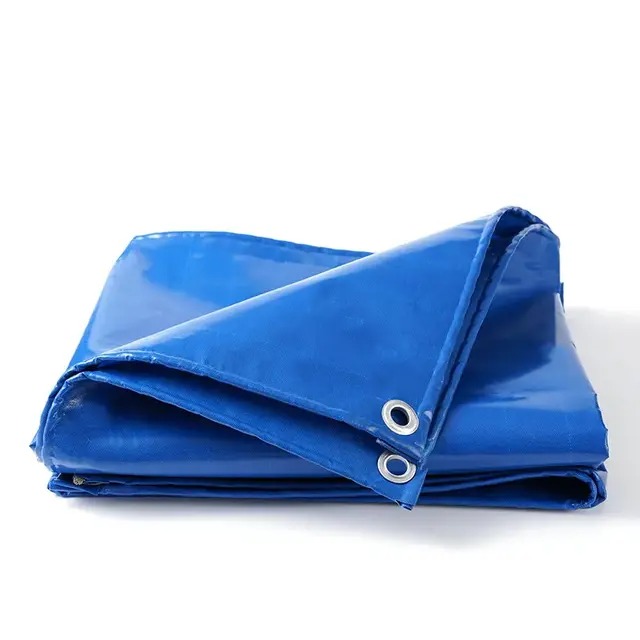
The core intent of any tarpaulin is to keep the elements out. In transport, "waterproof" isn't just about resisting a light drizzle; it is about resisting "wind-driven rain" at 60 miles per hour. This requires a coating that is chemically bonded to the fabric, not just sprayed on.
When inspecting a potential purchase, ask for the hydrostatic head rating. A Waterproof PU Tarpaulin or PU equivalent should ideally handle at least 8,000mm to 10,000mm of water pressure. More importantly, check the seams. Experts look for heat-welded or high-frequency welded seams. Stitched seams, even if treated with tape, are the most common failure points where water ingress occurs during high-speed transport.
Outdoor storage poses a different threat: ultraviolet degradation. Constant sun exposure breaks down the molecular bonds of polymers. A Premium tarpaulin must have UV inhibitors added during the manufacturing process. Without these, even a Heavy duty cover will become "chalky" and lose its High tensile strength within a single season. Look for materials rated for at least 2–3 years of continuous outdoor exposure to ensure you aren't replacing covers every few months.
In the world of transport, wind is your biggest enemy. As a truck moves, the tarpaulin experiences constant flapping and "buffeting." If the material lacks High tensile strength, a small puncture from a sharp corner of a crate will quickly turn into a massive tear across the entire sheet.
The strength of a tarpaulin comes from its internal "scrim" or base weave. This is usually measured in Denier (e.g., 1000D). A High-quality PU Tarpaulin or PU cover for transport should utilize a high-density weave. This prevents "propelling tears." Even if a sharp object pokes a hole, a high-strength weave keeps the hole from expanding under wind pressure.
Selecting a lightweight cover doesn't mean compromising on hardware. The eyelets (grommets) are where the tension is concentrated. Look for reinforced corners and double-stitched hems. In many Heavy duty applications, a PU Tarpaulin will feature brass or stainless steel eyelets spaced every 18 to 24 inches. This distribution of force is critical for maintaining the structural integrity of the cover when it is strapped down tightly over a load.
Depending on the cargo and the storage location, safety regulations might dictate specific material properties. For example, storing goods inside a warehouse or on a construction site often requires a Fire retardant certification.
In the event of an accident or a nearby fire, a standard plastic sheet can act as a fuel source. A Fire retardant PU Tarpaulin or PU cover is treated with chemicals that cause the material to self-extinguish once the flame source is removed. This is often a mandatory requirement for transport in certain industrial sectors, such as oil and gas or chemical logistics.
Sometimes, you need to see what is under the cover without removing it. This is where a Clear transparent PU Tarpaulin comes into play. It is frequently used for:
Greenhouse Storage: Allowing light in while keeping rain out.
Inventory Management: Viewing barcodes or labels on crates.
Construction Enclosures: Providing a Waterproof barrier that doesn't block out natural light for workers.
| Feature | Lightweight PU | Heavy Duty PVC | Clear Transparent PVC |
| Weight | Very Low | High | Medium |
| Durability | Moderate | Extreme | Moderate |
| Waterproof | Excellent | Excellent | Good |
| Best Use | Courier/Small Truck | Flatbed/Industrial | Construction/Enclosures |
Choosing a tarpaulin for transport requires a different mindset than choosing one for a backyard woodpile. Every inch of loose fabric creates drag, which increases fuel costs and wear on the material.
While a universal PU Tarpaulin is cheaper, a Custom fitted PU cover is far more efficient for transport. It reduces the "parachute effect" where wind gets under the cover. If you are a procurement officer, calculating the fuel savings of a tighter, more aerodynamic fit usually justifies the higher initial cost of a specialized lightweight PU solution.
Time is money in logistics. A lightweight PU cover can be thrown over a load by one person. This reduces labor costs and decreases the time a truck sits idle at the loading dock. Even if it isn't as Durable as a 20oz Heavy duty PU Tarpaulin, the operational efficiency often makes it the superior choice for high-frequency short-haul routes.
Transporting goods often involves exposure to road salts, oils, and exhaust fumes. Ensure the PU or PU Tarpaulin you select is chemically resistant. A High-quality coating will allow these substances to be washed off easily without staining or weakening the fabric. This keeps your fleet looking professional and extends the lifespan of the protective gear.
Before placing a large order for your fleet or warehouse, you need to perform basic quality checks. An "Expert Insight" approach goes beyond just feeling the thickness; it involves looking at the microscopic and chemical details.
Hold a sample of the PU Tarpaulin or PU fabric up to a strong light source. You should see a consistent, even distribution of the coating. If you see bright spots where the light shines through more clearly, the coating is uneven. These thin spots will be the first to leak and the first to fail under UV exposure.
Try to peel the coating away from the base fabric at a corner. In a Premium Heavy duty tarpaulin, the bond is so strong that the fabric should tear before the coating peels. If the PU or PVC film comes away easily, it will eventually delaminate in the wind, leaving your cargo vulnerable to water. Always prioritize brands that can provide a "Peel Strength" certification.
Even the most Durable Waterproof cover will fail prematurely if it isn't cared for. Proper maintenance is especially important for lightweight PU materials, which can be more sensitive to sharp edges and abrasive cleaning chemicals.
Never store a tarpaulin while it is wet. This leads to mildew and "polymeric breakdown," where the coating begins to smell and stick to itself. Use a mild soap and a soft brush to clean road grime off your PU Tarpaulin. Avoid harsh solvents, as they can strip away the Fire retardant and UV-resistant additives that keep the material safe.
Keep a repair kit on hand that includes PU/PVC adhesive and patches of the same material. Because these covers have High tensile strength, a small hole won't naturally close. Patching it immediately prevents wind from entering and tearing the hole further. A well-maintained Heavy duty cover can last twice as long as one that is neglected, significantly lowering your annual equipment spend.
In today's market, the price of raw polymers fluctuates based on global supply chains. However, the value of protecting your cargo remains constant.
While a budget PU Tarpaulin might save you 20% today, the cost of a single damaged shipment can be 100 times that saving. Investing in a Waterproof cover with a proven track record of High tensile strength is a form of insurance. For outdoor storage specifically, the labor cost of replacing a failed cover often exceeds the price of the cover itself.
For Long-Haul Trucking: Prioritize High tensile strength and lightweight PU for fuel efficiency.
For Construction Sites: Prioritize Fire retardant and Heavy duty PVC.
For Retail/Inventory: Prioritize Clear transparent options for easy scanning.
Selecting the right lightweight PU or PU Tarpaulin is about understanding the environment your cargo will face. By focusing on High tensile strength, Waterproof ratings, and specific features like Fire retardant coatings, you can protect your assets effectively. Remember that the "lightweight" promise of PU is most valuable when it is backed by a rugged, high-density base fabric. Choose wisely, maintain your covers, and your transport and outdoor storage operations will remain secure for years to come.
Q1: Can I use a lightweight PU tarpaulin for heavy flatbed trucking?
While PU is excellent for weight savings, it may not have the extreme abrasion resistance of a Heavy duty PU Tarpaulin. For flatbeds carrying rough-edged machinery, a thicker PVC option is usually safer. PU is better for boxed cargo or van-style coverage.
Q2: Is "Clear Transparent" tarpaulin as strong as solid colors?
Usually, no. Clear transparent PU Tarpaulin lacks the internal polyester scrim (the weave) that provides High tensile strength. It is great for visibility but should not be used as the primary structural cover for high-speed transport.
Q3: How do I know if a tarpaulin is truly Fire Retardant?
Look for certifications such as NFPA 701, B1, or M2. These indicate the material has passed specific laboratory tests for flame resistance. Do not rely on "flame resistant" labels without a corresponding technical standard.
We understand that in the world of industrial protection, there is no room for compromise. As a leading manufacturer with our own dedicated production facility, we specialize in crafting high-performance covers that meet the rigorous demands of global logistics. Our factory is equipped with advanced high-frequency welding machines and precision coating lines, allowing us to produce both specialized lightweight PU solutions and Heavy duty PU Tarpaulin that exceed industry standards for High tensile strength and Waterproof reliability.
Our strength lies in our control over the entire manufacturing process—from selecting the raw high-denier polyester yarn to applying custom Fire retardant and UV-resistant treatments. We pride ourselves on our ability to provide B2B clients with tailored solutions, whether you need Clear transparent panels for construction or thousands of Custom fitted covers for a transport fleet. When you work with us, you are partnering directly with the source, ensuring competitive pricing, consistent quality, and a commitment to protecting your most valuable assets.


